Central Pacific
Manuel Antonio: Where The Rainforest Meets The Pacific
Discover Manuel Antonio’s extraordinary meeting of rainforest, beaches, mangroves, marine environments and wildlife on Costa Rica’s Pacific coast.
3 min read
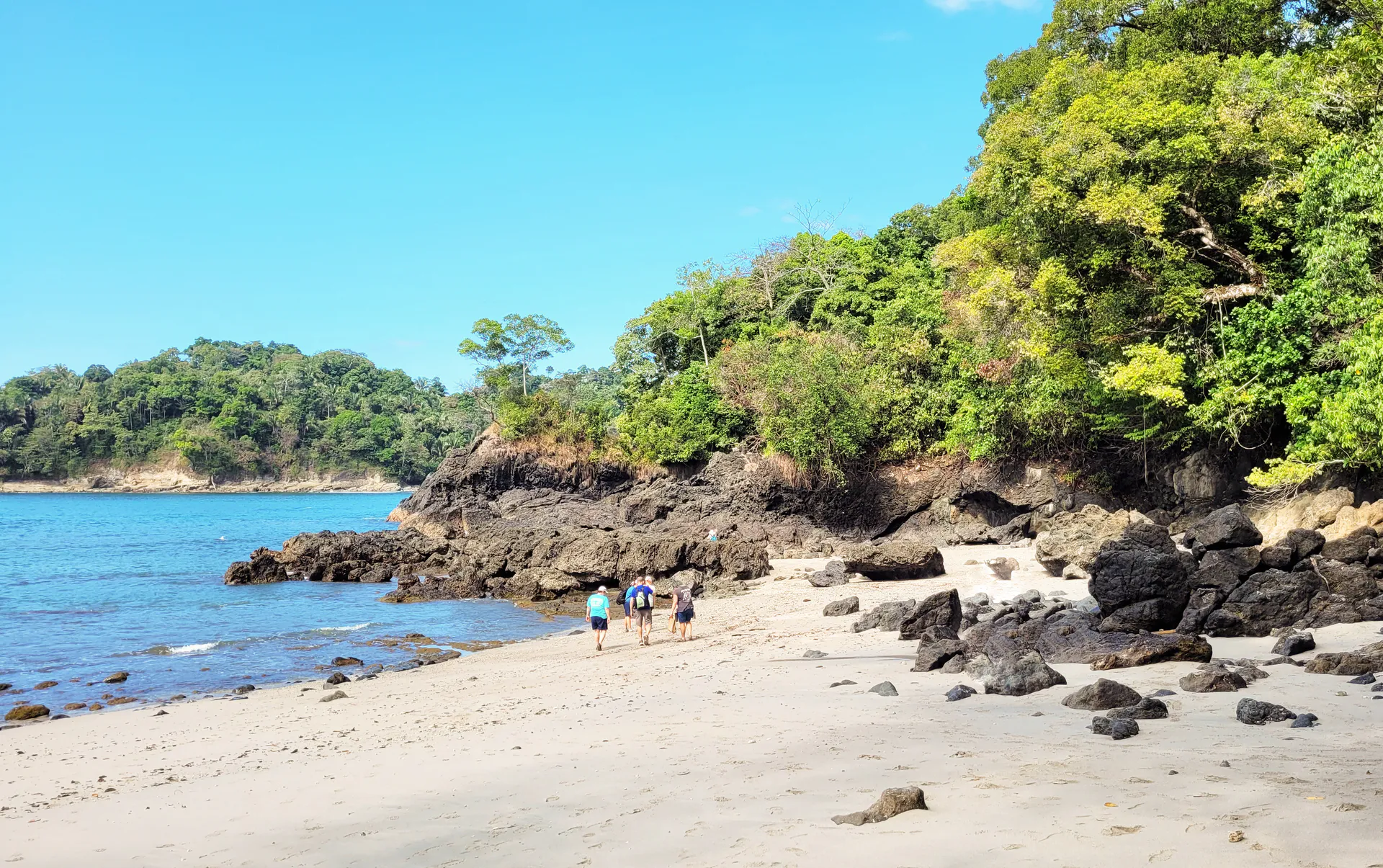
WHERE RAINFOREST MEETS THE SEA.
Costa Rica’s great landscapes often refuse to stay in one category.
Manuel Antonio is one of the clearest examples.
Very humid tropical forest meets Pacific beaches. Mangroves sit close to marine environments. Wildlife moves between canopy, trail and coast. The result is a protected area that feels compressed in scale but remarkably expansive in experience.
A SMALL PARK WITH A LARGE NATURAL PRESENCE
SINAC records approximately 352 bird species, 109 mammal species and 346 plant species within Manuel Antonio National Park, along with varied marine fauna.
Among the animals highlighted by SINAC are Central American squirrel monkeys—the park’s emblematic titi monkey—white-faced capuchins, howler monkeys, two- and three-toed sloths, raccoons and coatis.
Numbers are useful, but the atmosphere is the real story.
A trail can move through humid forest and open unexpectedly toward bright Pacific water. A wildlife sighting can happen above the path while waves remain audible through vegetation.
It is exactly the kind of overlap that makes Costa Rica memorable.
THE CENTRAL PACIFIC AS A CORRIDOR OF EXPERIENCES
From Jacó, the coast extends south toward a series of destinations with increasingly different character.
Manuel Antonio is one of the most recognized, but it belongs to a broader regional sequence that includes beaches, communities, rivers and forest landscapes along Route 34.
Living in the Central Pacific does not mean living next door to every national park.
It means having a coastline that keeps opening into new environments.
352 BIRD SPECIES.
109 MAMMAL SPECIES.
RAINFOREST, MANGROVES, BEACHES AND SEA.
SINAC records both two-toed and three-toed sloths in Manuel Antonio, along with three monkey species commonly associated with the park: squirrel, white-faced capuchin and howler monkeys.
A PLACE TO EXPERIENCE, NOT COLLECT
Popular natural areas deserve a slower kind of attention.
The value of Manuel Antonio is not “checking off” a beach and several animals before lunch. It is seeing how many ecosystems can exist together in one compact place—and understanding why Costa Rica’s conservation model matters.
Take less from the experience than you bring into it.
Leave wildlife alone.
Stay on designated routes.
Let the forest remain the main event.
THE SUEÑOS DEL MAR CONNECTION
Sueños del Mar is not positioned as a substitute for Costa Rica’s protected places.
Quite the opposite.
One of the privileges of living on the Central Pacific is being able to keep discovering the country beyond home. The community provides a private base in Jacó—close to everyday services, beach life and nearby experiences—while destinations such as Manuel Antonio expand the sense of what the larger region contains.
Home should make exploration easier.
Then it should feel good to return to.
Questions & answers
What ecosystems are found in Manuel Antonio National Park?
SINAC describes very humid tropical forest alongside beaches, mangroves and marine environments.
What wildlife can be seen in Manuel Antonio?
SINAC lists monkeys, sloths, raccoons, coatis and hundreds of bird species among the park’s fauna. Sightings vary and are never guaranteed.
Is Manuel Antonio part of the same Pacific corridor as Jacó?
Yes. Both are connected along Costa Rica’s Pacific road network, with Manuel Antonio farther south. Driving conditions and times should be checked before travel.